Showing posts with label Racehorse Rescue. Show all posts

Monday, December 5, 2011

Just "Banning" Can't Be the End of the Line for Advocates

Last week President Obama signed a bill (passed by a bipartisan coalition that passed the bill in the first place – please don’t let your own political biases let you lose sight of the fact that this had to pass both houses of Congress before it even reached the President’s desk) that authorized the hiring of slaughterhouse inspectors effectively reopening the horse processing business in the United States after years of a defacto ban on slaughter (no inspectors = no slaughterhouses).  The outcry for animal rights advocates and horse people has been deafening.  I’ve been reading on Facebook, Twitter, newspapers and magazines what a tragedy this development is.  I don’t necessarily disagree, but there is one thing that I haven’t read beyond the outrage; the solution.

This is meant to be serious.  I’m looking for real answers here, not “It’s so awful”; “They are beautiful”; “You can’t kill Black Beauty”, etc. 

My question is:

Given the thousands of unwanted horses in this country right now, if the horses cannot be sent to slaughter – for human or animal consumption overseas – what happens to them?

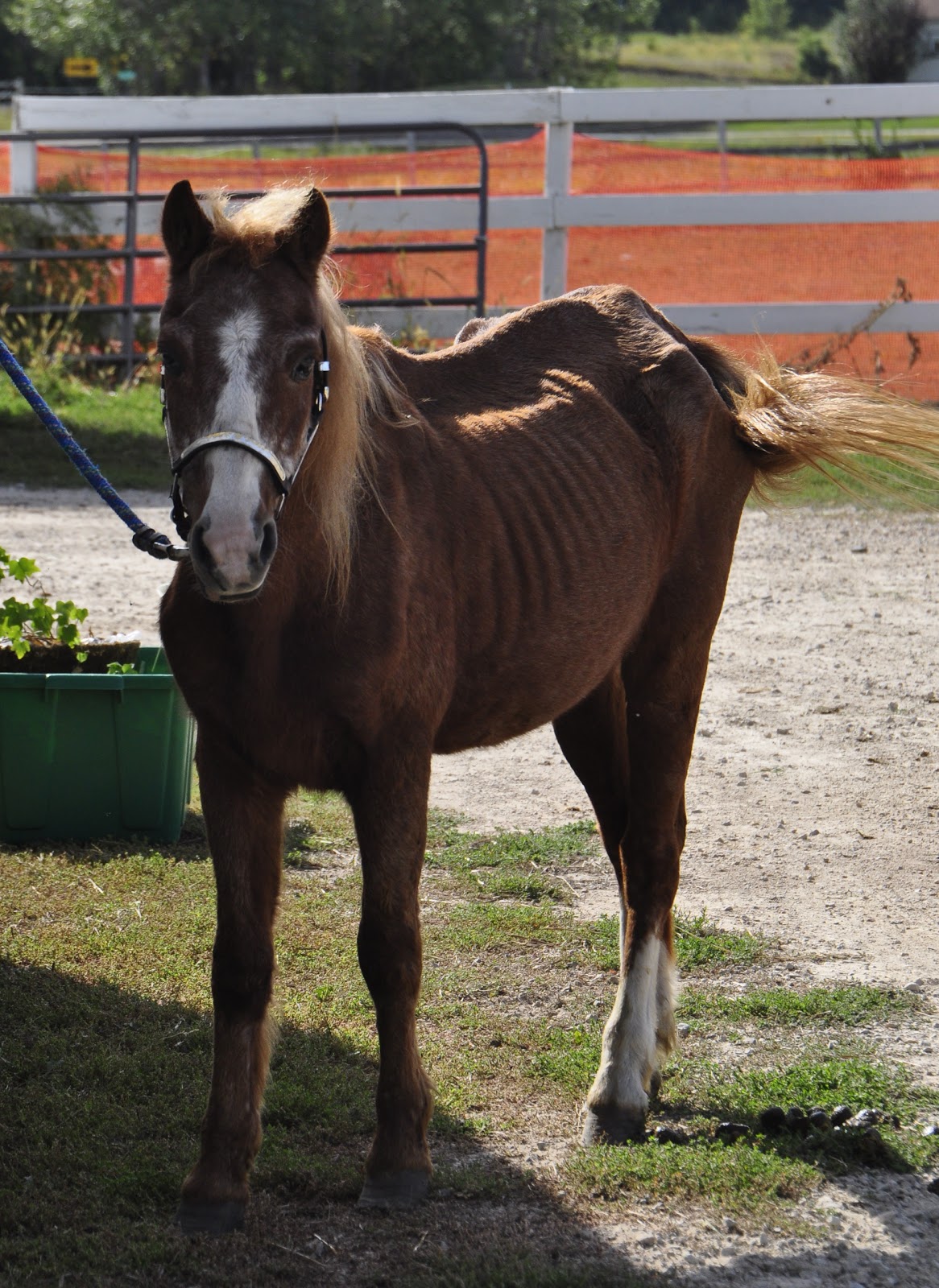
I’m serious.  I’ve been to the feed lots and seen these poor animals in the midst of starvation.  Contrary to popular belief, 99.5% of them were NOT registered Thoroughbreds.  Organizations that exist to help these animals are starved for cash and assistance.  These animals are expensive to care for, even under the best of conditions.  All the hollering that I have seen online and I understand it - the thought of Tabby Lane, Fizzy Pop or any other horses being sent to slaughter is almost unbearable to think about – none of it addresses the problem of what is to be done with all these horses.

If there is not enough money, not enough volunteers and a bad economy – what happens to the thousands of horses every year that are abandoned?  By some estimates over 100,000 horses are being sent to Canada and Mexico.  How do they all get saved?

Population control?  Absolutely.  Just because a horse has a uterus doesn’t mean it needs to be a mom.

More support for after racing programs?  This is ongoing and growing.  Racing is starting – starting – to do a better job taking care of its own.  Ex-racers only account for a very small part of this 100,000.  We’re just an attractive target because of the publicity and money involved, but more attention, giving and financial programs are being put into place to support and retrain ex-racers.

But what about the rest of the population?  It’s easy to cry “STOP” but much more difficult to derive a solution.

I’m not advocating slaughter, mind you, but want to hear solutions over the clamor.  All that has happened since slaughter was defacto banned in the US were more horses were exported to Canada and Mexico and left to starve to death in fields. 

I’d like to hear some solutions along with the hand-wringing.  “Winning” by re-banning slaughter isn’t enough.  Sure, “advocates” could pat themselves on the back and talk of a job well done, but the problem of over-population didn’t disappear – only the end result. Moving the problem doesn’t solve the problem.

If you actually get lawmakers to change their collective mind on this issue, what happens to all the horses that you “saved”?  They’re still going to slaughter, only somewhere else.  Your job isn’t done; it’ll only be just beginning.

You didn’t solve the problem in the last five years, so what will you do if you get a second chance?

Monday, September 19, 2011

Racehorses, Responsibility and Heroines

             Off the Track Thoroughbreds - playing, sound and adoptable at the MNRRP

I went to my first non-racehorse auction the other night with Annie Ringwelski and Jen Selvig of the Minnesota Retired Racehorse Project (MNRRP).  Our mission, well, their mission, was to try and identify off the track thoroughbreds (OTTBs) and do what they could to bring them into the program and get them rehabbed, retrained and placed in a good home.  For some background on the MNRRP, you can go back in this blog or visit theirs at www.retiredracehorses.blogspot.com.

The night started simply enough.  I arrived at the wrong building and waited.  I texted Annie, knowing that she would be the first to arrive, and told her where I was.  What I didn’t admit was I had a knot in my stomach.  I didn’t know what to expect and my biggest fear was that there would be OTTBs there from the recently concluded Canterbury meet.  Even bigger was that I would recognize them and that they would have come from a trainer or owner that I knew.  I expected horrible conditions and cramped quarters.  Basically I feared the absolute worst.

When I got to where I was supposed to be, I surveyed the auction.  The arena was clean and tidy.  Stall space was nothing special, in fact I would consider it quite cramped, though the horses were only in for the auction and then moving on.  Picture your standard racetrack stall and chop it into thirds and there you go.

One special section was set aside for “loose horses”.  These would not be presented in the ring or ridden in to show off their skills.  These were horses that, if they struck your fancy, you could buy cheaply at the end of the auction as they ran loose.  If not, they were destined for the slaughterhouse.  They were run through the ring quickly and were kept in makeshift pens.  Three pregnant mares were together as were several yearlings with one elderly and emaciated pony and a couple of adults.  All were sold to dealers except the pony who was taken home by Annie’s daughter Daria who spent her own money to save her.  It’s not many nearly 13-year olds with that kind of compassion and heart.

      Ginger the Pony, saved by Daria!
The auction was an all-breed auction but our hunt was very specific – we were on the lookout for OTTBs.  Because the Canterbury and Prairie Meadows meets had just ended there was the very real possibility that some racers would have fallen through the cracks and ended up here, thankfully that was not the case...at least not here.

One of the first people we bumped into after entering the auction was a gentleman that had purchased horses with assistance from Project in the past.  He had an OTTB, though not purchased through the program, entered in the sale.  It had a stifle issue and he knew he wouldn’t get much for her but was going to send her through anyhow.  I freely admit that I don’t know the motivation, but it certainly appeared by his body language that he was surprised to see Annie there.  My guess is that he felt “caught” and that prompted him to withdraw her, though I could be wrong.  MNRRP will now market the horse for him and make sure it gets placed in a good home – much better than a slaughterhouse.  Victory number one. (She was privately sold this weekend as a hunter/jumper prospect.)

A little later as we perused the stalls and the kill pen we found a tattooed Thoroughbred.  Jen ran the tattoo through The Jockey Club database and we discovered that the horse was a 9-year old gelding named Money Train.  Money Train raced in Ohio and West Virginia and was able to win three races: a maiden and two allowances before starting to have trouble winning at the $5000 claiming level at Mountaineer.  He was retired soon thereafter and went through the rehabilitation program at New Vocations in Lexington, KY.

He was placed with Bailey Saylor of Minnesota.  Here is the description of that relationship straight from the New Vocations website:

Adopter Barry Saylor of Minnesota and Thoroughbred gelding “Money Train” aka “Cash” have covered over 395 miles of terrain in 2009 competing in endurance rides of 25-60 miles in length.  He even plans to do a 100 mile ride next year! According to Barry, he could not ask for a better horse than “Cash”. He has the whole package for a sport that demands a lot from a horse. He is the best OTTB that he has ever had. He has the attitude; loves to go down the trail even at the 50 mile mark, takes care of himself on the trail, and has the physical attributes to enable him to accomplish the miles and stay sound.  “I can’t keep track of the compliments that I get on how gorgeous he is when we pass someone going down the trail. He has stolen my heart with his personality, intelligence and his drive. He is a wonderful animal. Thank you for making our being together possible.”

The note that was left at the auction house for the horse gave some background about his endurance riding capabilities as well as a general description of his exemplary behavior. 

Just after Money Train was identified, it was his turn to get sent through the ring.  We literally ran back to the arena and jumped into the stands just in time for the bidding to begin.  Initially the only bid was from a kill buyer and that was Annie’s signal to get into action.  The bidding was raised a few times but there was only two-way action.  Once the price got too high for the kill buyer to make a profit, the horse was property of the MNRRP - $210. 

It was exhilarating.  Victory number two.  Sure, the gelding through the ring was just one, but it was a racer and a well-trained one at that.  He certainly didn’t deserve to be dumped here.  The goal of the program now will be to get him to a qualified new home as soon as he is ready.  Considering he had been off track for a while in another discipline “Cash” will hopefully have a short stay since his down time to recover from the racetrack is non-existent.  Still, work will have to be done with him in order to prove his soundness and readiness to move on.  The adoption fee should cover his costs and provide a bit extra to be able to help another OTTB, giving the program the ability to grow and help more horses in need.  If there is one thing that is certain in this world of the OTTB: there is more supply than help available.

I was Tweeting (@tlgrevelis, if you’re interested in following) as the experience was unfolding and Caroline Betts of the Southern California Thoroughbred Rescue immediately sent a response to a Tweet that she was sure Cash was a New Vocations horse.  I was able to send a note to New Vocations through Facebook, giving them the heads up and the next day they were able to get in touch with Annie to give her his specifics.  They were thankful that we were there and were able to prevent him being sold by the pound.

During the walk through the kill pen – excuse me, the loose horse pen – I spotted a large paint, possibly part Saddlebred.  He was magnificent.  He had one of the most beautiful heads I’d ever seen and he was very tall, over 16 hands high.  He looked regal and totally misplaced in that pen.  He allowed himself to be patted and seemed friendly, but as with the other kill pen…loose horse pen…horses, you never know what you’re getting.

 
The saved part Saddlebred paint and yours truly at the farm. 

There was something about him, though, that gnawed at me.  He wasn’t an ex-racer, so he couldn’t be a program horse so I resigned myself to the fact that this guy was getting shipped south, but he ate at me.  There is a lot I’m still learning about judging a horse, but something with him just didn’t feel “right”.  The next day we tried to raise enough money to buy him back from the kill buyer.  Thanks to various friends and the networking available through social media, we were able to post his bail.  I’m looking forward to helping out with him as he moves forward.  I’m sure you’ll read more about him in this space as time goes by.  While I was thrilled to pieces to get him out of there and a shot at a good life, what it led to was even more disturbing and was right in the Project’s wheelhouse.

When he was being picked up at the feed lot, a pen was discovered with five Thoroughbreds and another outside.  All of the five still had their racing plates on. 

These horses were purchased off the track by a known dealer who likes to say he has “a good riding home” for them, forks over a couple of hundred bucks and away they go to Mexico or Canada.   Donating your Thoroughbred to the Project or another program can get you a $5000 tax credit.  Selling to the dealer gets you $200 cash.  Is it really worth it?

An outpouring of support from some of the local horse community, most notably from Minnesota Thoroughbred Association Board President Scott Rake among others, enabled the Project to save several of the horses, though it was already too late for one and an unraced Kansas bred.  These horses are now in the program and can be read about at the MNRRP blog.

The entire experience was a roller coaster ride.  The heartbreaking discovery of the OTTBs at the auction; the exhilaration of being able to save them for new careers; the high of knowing that no thoroughbreds fell through the cracks only to be brought crashing down to Earth the next day finding six in the feed lot; the last minute reprieve for the four, but not being able to save the other two.  This was just two days in my life – this IS the life of the MNRRP.

The strength and dedication of these women is phenomenal.  The deep well of compassion they possess tempered by the harsh reality that you can’t save them all is admirable and remarkable.  Quite frankly, anyone who wants to own a horse – racehorse or otherwise – should have to experience what I did.  They should have to see the pregnant mares that will be slaughtered along with their unwanted and unborn foals.  They should see the fear in the eyes of the weanlings who never asked to be born and will only live a short and brutal life anyway.  They need to see the starving and emaciated ponies that were simply discarded.  Reckless breeding and even more reckless ownership needs to be avoided.  A look at the harsh reality of what can happen "after" would promote more responsible ownership in all phases of equine activity.

It's important to recognize that while racing gets a bad rap, out of the 110 or so horse in the feed lot for shipment, only five were ex-racehorses.  The remainder were dumped by owners involved in other disciplines or had them as pets.  Even at the auction we only found 2 OTTBs compared to the hundreds run through the ring.  Racing may not be perfect, but it is far from the largest cause of the problem.

If you’re in the game – an owner, trainer or even a fan, support your local organization that helps to retire these horses to another life and career.  As a reminder, in Minnesota you can reach the MNRRP at 612-384-6908 or send a donation to MNRRP C/O Annie Ringwelski, 3850 182nd St E, Prior Lake, MN 55372. 

Friday, August 19, 2011

Tabby Lane Gives Back


When you own and race horses, there is a certain responsibility you have to the animal.  There is a lot of debate as to who should be looking out for our ex-racers when their careers are over.  Some say the breeders while others task the owners.  While there are good arguments for both – as well as others - the bottom line is that right now not enough is being done to take care of our retired racehorses.

There is a good chance that those of us in the claiming game will have horses pass through our stables for only a few races but that doesn’t absolve us of responsibility to these athletes.  When we got together to claim a horse, I borrowed from Steve Zorn's Castle Village Farm a provision to set aside 1% of earnings to go to equine related charities.  In the past we have donated to the Don MacBeth Disabled Jockey’s Fund but this year we decided to stay local and changed focus to the equine.  This year the recipient of 1% of Tabby Lane’s earnings is the MinnesotaRetired Racehorse Project.

The 501(c)(3) charity was founded by Director Annie Ringwelski and Vice-President Dr. Jennifer Selvig, DVM, in 2009 to provide “rehabilitation, placement and promotion of retired racehorses.”  Since their inception, they have placed or helped facilitate placement of over 70 ex racehorses.  Horses that have gone through the MNRRP program are already excelling in cross country, barrel racing, dressage, polo and recreational riding.  The program is 100% volunteer and the majority of the expenses and daily operations are born by Ringwelski while Selvig lends her expertise to evaluating and treating, if necessary, entrants into the program to keep associated costs as low as possible.

Just yesterday morning I read a Facebook exchange that was heartbreaking:

Trainer: “Annie, we have a horse for you.”

Annie: “Can't take anymore right now until a few find homes. We are full with no funding.”

The trainer is a stand-up guy who is going to try and do right by the horse, but options are limited.  This isn’t a Minnesota issue, as many of your know.  This is an issue that is national in scope and organizations like the Southern California Thoroughbred Rescue, Neigh Savers, Illinois Equine Humane Center, New England Equine Rescues as well as MNRRP exist to fill this need.  The rest of us in the game need to support these organizations in any way we can.

“A bale of hay is $5,” says Ringwelski.  “No donation is too small and every bit of it goes to help the horses.”

MNRRP currently has 8 retired racehorses available for adoption or in various stages of rehabilitation. Demand for the program is so high that here is a waiting list for trainers and owners wanting their horses in the MNRRP program, which carefully screens potential adoptive homes.

"We have the room for them at our facility, we just don’t have the financial backing to support them,” said Ringwelski. “It breaks my heart to walk by an empty stall and know there is a horse in need out there."  

A noble cause with no funding is just a dream.  I’m hopeful that we in the industry can keep these groups living their dreams to help our ex-racers find long and useful lives beyond the racetrack.  Wherever you are, please support your local rescue.  Every little bit helps and it is our obligation.

As Annie said, no donation is too small.  If you'd like to donate please send a check to MNRRP C/O Annie Ringwelski, 3850 182nd St E, Prior Lake ,MN 55372.  The Project’s number is 612-384-6908.

Tuesday, January 18, 2011

Eclipse Awards a Chalky Affair

It was a chalky Eclipse awards last night in Miami. There were no real surprises during the evening – including Kenny Rice’s horrible jokes – leading up to the Horse of the Year coronation of Zenyatta. That moment was a surprise for me. Racing has always had an “old school” mentality and art of that mentality is that awards and champions are decided on the track. Be it a nose or nine lengths, Blame won the battle on the track and I suspected that would carry over to the vote. As close as I thought the vote would be, it really wasn’t. Blame finished with 102 votes, Goldikova with 5 but the queen smoked them all with 128.


Some takeaways for me on the evening:

- Acceptance speeches for the most part were God awful with the connections of Dubai Majesty taking the cake;

- Omar Moreno was sincere and heartfelt when he said that winning the Best Apprentice award was the best moment of his life;

- Kenny Rice needs to go. His jokes were not only flat, but in several instances sexist. I’m not easily offended (I’ve been in racing and gaming for 12 years!) but he managed to do it. Second bad year in a row, time to move on;

- The Moss’ were as gracious in victory as they were in defeat;

- Al Stall, Jr., while clearly disappointed, gave an equally gracious interview at the end of the night.

- Marylou Whitney pinning the responsibility for OTTBs on the owners was only about 40% correct. As Teresa Genaro pointed out during the Thoroughbred Times live chat during the ceremony, Breeder’s play a large role in the proliferation of horses as well (percentages were mine).

I can’t let Mrs. Whitney’s comments go untouched here. I am sure that from her perspective owners should care for their horses from birth until death, but that is easier said than done. She deals in the blue bloods. It’s not often that you’ll find a Whitney horse running in a $5,000 claiming race at Beulah Park. When you are talking about claiming horses that may change hands a dozen times over a career, they are much tougher to keep track of. While you can stipulate on a horse’s papers that you want to be contacted if the horse is going to be retired/sent to slaughter, you are also relying on the integrity of that last trainer/owner to honor your request. As hard as it is to believe, there are some unscrupulous characters running around the racetrack and the draw of money now versus maybe a few bucks later is too much for many.

Breeder’s need to step up and more minor fees need to be assessed that go to the retirement of racehorses. Hopefully the recession has stopped the practice of overbreeding racehorses. The decreasing foal crops should at least allow the supply to start running more in line with demand in a few years.

In addition, support your local retirement charity whether you are a fan, owner or just plain horse lover. So many wonderful groups exist around the country from CANTER to ReRun to Neigh Savers, Southern California Thoroughbred Rescue and even right here in Minnesota where we have the Minnesota Retired Racehorse Project. Pick your favorite and lend a hand.

Finally, there are some Blame fans that were clearly not happy with the outcome. As I mentioned yesterday, I would have voted for Zenyatta but I can certainly understand the sentiment: when you win on the track, that’s supposed to be enough. As many of Zenyatta’s other opponents have found out, against her your best is rarely enough. She is a deserving champion.

Congratulations to all the winner’s tonight. Enjoy the after party!

Tuesday, October 12, 2010

Do the Right Thing


A recent Blood-Horse ‘Special Report” focused upon unwanted horses and how the industry deals with the horse’s career after racing. The fact is, for a long time the industry DIDN’T deal with it at all. We’ve tried very hard to ensure a quality life for our racers when their careers are done, something I learned from bloodstock agent David Miller when I owned part of my first Minnesota-breds several years ago. Siblings Somerset Sam and Somerset Wish were part of an earlier partnership I was a part of and both were retired with dignity – Sammy to a farm in Minnesota where he has been retrained and is learning to compete again in another discipline, and Wish to a polo farm in Wisconsin under the ownership of former partner Brian Nodolf.

This summer I was faced with the challenge of placing a horse under our care when it became apparent that she did not have a career on the racetrack. It’s one thing when you own a horse of your own and have to answer to no one but yourself. It’s quite another to have to go back to the partners and tell them that their horse will never run a race after several months of carrying her financially.

For the most part, the partners understood. Many had either owned horses before or were familiar enough with the business to know that this happens. Some were not and were less understanding, but the fact remained that One for Zetta (Ballado Chieftan – Zach’s World) was not cut out to be a racehorse and we needed to find her a home.

Her trainer, up and comer Christine Riddle, gave it one helluva go. Zetta would run all day and looked like a racehorse. However, once you turned her around on the track to set down for some speed work, she wanted nothing to do with it. The time came over the summer where we needed to make a decision. In the interest of the partners and in the interest of the horse we decided to retire her.

While the decision to retire her was hard, it turns out it was much easier than selling her. As you can imagine, in this economy selling a horse is next to impossible. We had a few folks that were interested, but for various reasons she didn’t meet their requirements. She is a beautiful mover and is nicely conformed, but buyers were not there. A buyer was my first priority since I have a responsibility to my partners to get them something for their investment but as the meet started to wind down in August, the market was being flooded by Off the Track Thoroughbreds and there was too much, too cheap.

We turned to the talented horse lover Brenda Rick. Brenda had taken in Sam and had Z’s mom, Zach’s World, and loves her to pieces. Like everyone else, Brenda wasn’t in a position to buy Z, but came back with an intriguing offer: in exchange for Z, the group would get either her offspring or a foal of her mom’s. Now by the time that comes, the members may or may not want to be involved, but it was something and, most importantly, I knew that Brenda would love Z and treat her right. Now she is being retrained and, as you can see, is enjoying the work!

Things may not have worked out for One for Zetta, but I hope that by doing the right thing we can create a bit of karma and, besides, sometimes the right thing to do is, quite simply, the right thing to do. Much thanks go out to the partners, Christine, Brenda and David. It was a team effort and all deserve the credit for helping to do right by the horse.

Wednesday, February 3, 2010

Neigh Savers Foundation on Blog Talk Radio

I hope you'll join me tonight at 9 PM Central Time on Blog Talk Radio when my guest will be Karin Wagner, founder and Executive Director of the Neigh Savers Foundation, a California based horse welfare organization. We'll discuss the latest rescue efforts, how the economy is affecting the placement of off the track race horses and California racing. Catch us live or download from iTunes after the broadcast!

Tuesday, August 11, 2009

Minnesota's Own

Over the years I've been writing this blog, I've always tried to put out the word on horses in need as well as the organizations that are the first to rush to their aid. Many excellent organizations have been showcased here like Neigh Savers, Southern California Thoroughbred Rescue, and the Illinois Equine Humane Center to name a few. Now we have one to call our very own here in Minnesota: Standing in the Gap.

Standing in the Gap is the labor of love of Darla Jeffery, a Minnesotan with a passion for horses. She started Standing in the Gap last year when she recognized the void in the care of injured racehorses. Her goal, supported only at that time by husband Fred, was to rehab injured horses so that they can go on to productive lives as mentors for returning veterans. Everyone who has ever worked with horses know about their inherent compassion and kindness (mostly...there are always exceptions to this rule!) and Standing in the Gap looks to bring this undercurrent of understanding and acceptance to our veterans. Here is their mission statement:

We will stand in the gap for injured thoroughbred racehorses just moments off the track. We will provide nurturing care, rehabilitation, and training for these fallen athletes. We will guard their dignity with our integrity; teaching them - through love, commitment, and endurance - to become effective mentors for our returning military vets.

So far, their first two reclamation projects, Maverick and Solo Tour, have been a success - though Solo is still most definitely a work in progress. Both horses raced at Canterbury Park and had relatively successful racing careers before they were taken off the track due to injury. No one knows where life was going to take them, but Standing in the Gap stepped in (with the aide of compassionate and caring trainers) and have been healing and then utilizing trainer Mary Schenck to retrain them for their career after racing. In fact, the Solo Tour recovery was captured on video and is available on their website. About the same time Solo joined Standing in the Gap, so did Leslie Morely, another local woman who shares Darla's passion and dream, and the SITG rounded into shape.

To the right you will see a new widget. This widget is a fundraising widget to help support this new 501(c)3 charity and all donations are tax deductible. I know there are readers here from all over the country and I do appreciate all you have done in the past and ask for your help once again. But I'd like to make a special appeal to all of you that read locally in Minnesota, the Dakotas, Iowa and Wisconsin and, to one degree or another, are involved in racing at Canterbury. Please do what you can - a $10 donation from all of us (and I've kicked that off already) - would go a long way in helping to provide the resources to care for Maverick, Solo Tour and also give them the opportunity to go after more horses in danger of falling through the cracks.

Sunday, July 5, 2009

Minnesota Nice - Equine Edition

From time to time in this space I drop in a post about a favorite horse, a major horse rescue effort or an organization trying to make headway in giving retired racehorses a chance at a new career. Today features one of those stories and one that is close to home for me. Standing in the Gap is a non-profit based in Minnesota to help horses in need. The video below, sent to me by Darla Jeffery (filmed by Leslie Morely) does a marvelous job chronicling one rescue story that took place right here at Canterbury Park.


As Darla does at the end of the video, I would also like to thank Max Henderson, trainer of Solo Tour, who made the one phone call in order to spare Solo an uncertain fate. I know that there are more like Max out there, and I'd like to thank each and everyone of you who have made that call and, maybe more importantly, have spoke to your fellow horsemen about making that call.


Please watch the video and visit Standing in the Gap and, if you can, give a little. especially the hundreds of Minnesotans that visit this blog each month. Even $5 or $10 from each of you will make a huge dent in their expenses.


Wednesday, May 13, 2009

It's Rescue Time

From time to time I dedicate this space to horses in need of rescue. I try not to overdo it as this is about Owning Racehorses, not Rescuing Racehorses and besides, people don't want to be chronically hit over the head. Once a month to share stories and, yes, plead for help, is not too often I don't think. In fact, it's part of our obligation as race horse owners. This space has been used by folks like Janine Starykowicz of the Illinois Equine Humane Center, the Southern California Thoroughbred Rescue and, of course, old friend Karin Wagner of Neigh Savers.

This month we're focusing on a Thoroughbred gelding named Dark Nose (Bertrando - Cookin Vickie - Far Out East) who came to Neigh Savers by surprise. The van pulled up to Destiny Ranch with it's expected load of a single horse and out came four! The other three horses were in pretty good shape but Brownie (as he is nicknamed) is in pretty tough shape. He is lame on three legs, has locking knee cap syndrome, an old bow, a sore check ligament and a potential stifle problem. This six-year old sweetie has a great disposition and a will to live, but without help, it simply won't happen. His issues are many and resources are precious few.


Click on the Destiny Ranch link above and see more pictures of Brownie and the other horses boarding at the Ranch. If you can, please help Brownie with a donation. Every little bit helps.

Monday, April 20, 2009

TBA Giving Back

You'll notice on the homepage this week there are some new additions. The Thoroughbred Bloggers Alliance is looking to give a little back. For those of you that don't know, the TBA has always been active in supporting Old Friends through the annual dues of our members. In addition, virtually all of the membership support equine charities on their own. On the homepage you'll now find widgets to some of those organizations where you'll be able to click and make a contribution via Pay Pal.

Currently "widgetized" on the home page: Neigh Savers Foundation, Canter - California and Remember Me Rescue. These widgets will be up through the Derby, so there are a few short weeks to help make a big impact.

To give you an idea of how your money helps, Karin Wagner, Executive Director of Neigh Savers, sent out a list of what your contribution can mean to our retired racetrack athletes:

· Your gift of $5 will provide a days' worth of hay for one horse.
· Your gift of $35 pays for one farrier care (hoof trim).
· Your gift of $75 pays provides 5 bales of hay for a needy horse in our community.
· Your gift of $150 provides wormer for 30 horses.
· Your gift of $200 provides annual dental (teeth floating) and vaccination for one horse

See, even a small contribution helps provide the basics like hay! To learn more about Neigh Savers, just click on the name or here to read their latest newsletter about all the good work they are doing. To learn more about and contribute to the charities on the home page, visit the Thoroughbred Bloggers Alliance homepage and click on the widget of your choice. Every little bit helps. I hope you'll use this time as we lead up to the Kentucky Derby to throw a bit of the wagering dollar to the Thoroughbred related charity of your choice.